
VAT Registration in UAE | Process, Documents & Benefits|2025
VAT Registration in UAE – A Complete Guide for Businesses
Introduction
Value Added Tax (VAT) was introduced in the United Arab Emirates on 1 January 2018, marking a major step in aligning the UAE’s economy with global standards. The VAT registration in UAE is a mandatory requirement for businesses that meet the prescribed turnover threshold. It ensures compliance with the Federal Tax Authority (FTA) and allows companies to operate legally and transparently in the market.
This guide explains everything you need to know about VAT registration in UAE, including eligibility criteria, process, required documents, and benefits.
What is VAT in the UAE?
VAT (Value Added Tax) is an indirect tax levied on the consumption of goods and services at each stage of production or distribution. In the UAE, the standard VAT rate is 5%, which is added to the selling price of most goods and services.
Businesses act as intermediaries collecting VAT from customers and remitting it to the Federal Tax Authority (FTA).
Who Should Register for VAT in UAE?
Businesses must consider VAT registration in UAE based on their annual turnover and business activities. There are two types of registration:
-
Mandatory VAT Registration:
-
If the total value of taxable supplies and imports exceeds AED 375,000 per year, registration is mandatory.
-
-
Voluntary VAT Registration:
-
If the total value of taxable supplies and imports exceeds AED 187,500, businesses may register voluntarily.
-
This is beneficial for startups and small businesses that wish to claim input tax credit.
-
Exempted Businesses
Not every business is required to go through VAT registration in UAE. Certain sectors are exempt from VAT, such as:
-
Financial services (specific categories)
-
Residential properties (except new ones sold within 3 years of completion)
-
Local passenger transport
-
Bare land transactions
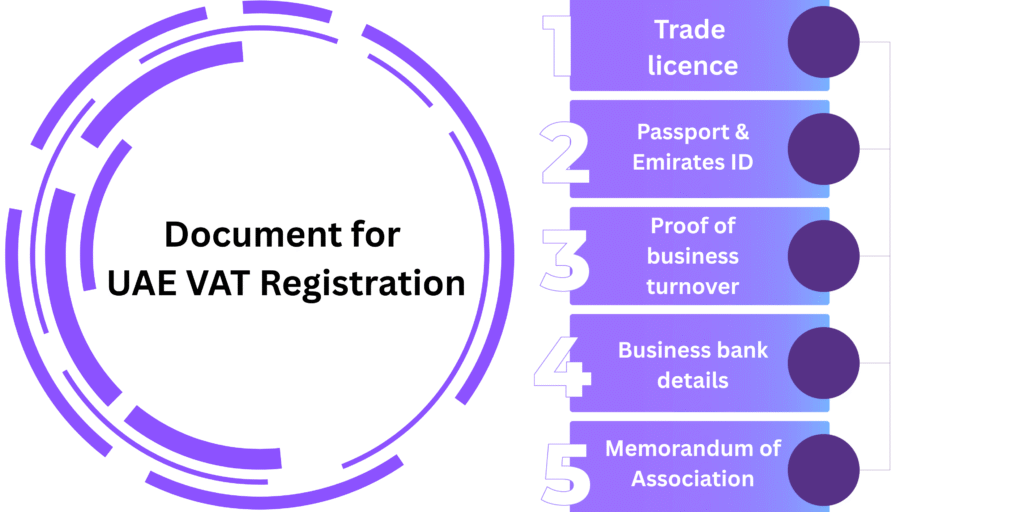
Documents Required for VAT Registration in UAE
To complete your VAT registration in UAE, the following documents are typically required:
-
Trade license copy
-
Passport copy of the business owner or partners
-
Emirates ID copy (if applicable)
-
Contact details of the business (email, phone, address)
-
Memorandum of Association (MOA)
-
Bank account details of the business
-
Turnover declaration for the last 12 months
-
Estimated turnover for the next 30 days
-
Import/export details (if applicable)
Having these documents ready ensures a smooth registration process.
Step-by-Step Process for VAT Registration in UAE
The VAT registration in UAE process is straightforward but must be done carefully to avoid penalties.
Step 1: Create an e-Services Account
Visit the Federal Tax Authority (FTA) portal and create an account using your business email ID.
Step 2: Access the VAT Registration Form
After logging in, click on “Register for VAT” and fill out the online application form.
Step 3: Provide Business Information
Enter details such as:
-
Business name (as per trade license)
-
Type of business activities
-
Bank account information
-
Annual turnover details
Step 4: Upload Supporting Documents
Attach all required documents in PDF or JPEG format.
Step 5: Submit the Application
Once the form is completed and verified, submit it to the FTA.
Step 6: Receive VAT Registration Number (TRN)
After approval, you’ll receive a Tax Registration Number (TRN) — a unique 15-digit number identifying your business as VAT-registered.
VAT Return Filing After Registration
Once VAT registration in UAE is complete, businesses are required to:
-
Charge VAT (5%) on taxable supplies.
-
Maintain proper accounting records.
-
File VAT returns quarterly or as required by FTA.
-
Pay VAT dues within the prescribed time to avoid fines.
Failure to file returns or pay VAT on time can result in severe penalties from the FTA.
Benefits of VAT Registration in UAE
Registering for VAT provides several advantages to businesses operating in the UAE:
-
Legal Compliance: Ensures that the business operates within UAE tax laws.
-
Enhanced Credibility: Improves trust with customers, suppliers, and investors.
-
Tax Credits: Enables the company to claim input tax on purchases.
-
Transparency: Promotes accurate financial reporting and accountability.
-
Business Expansion: Mandatory for trading with VAT-registered companies and government contracts.
Penalties for Non-Compliance

Businesses that fail to complete VAT registration in UAE within the required timeframe may face:
-
AED 10,000 for failure to register within the deadline.
-
Additional fines for non-filing, late payment, or incorrect submissions.
It’s crucial to monitor your turnover and register as soon as you become eligible to avoid penalties.
Voluntary VAT Deregistration
In some cases, businesses may choose to deregister from VAT if:
-
The annual turnover drops below the voluntary registration threshold of AED 187,500.
-
The business stops making taxable supplies.
Applications for deregistration can also be submitted through the FTA portal.
How Global Strategic Can Help
At Global Strategic, we assist businesses with seamless VAT registration in UAE, ensuring full compliance with FTA regulations. Our tax professionals help you:
-
Determine eligibility for VAT registration.
-
Complete the online application process.
-
Maintain VAT accounting and return filing.
-
Avoid penalties through timely submission.
Our expert guidance simplifies the entire VAT registration in UAE process, allowing you to focus on growing your business.
FAQs About VAT Registration in UAE
1. What is the VAT rate in UAE?
The standard VAT rate in UAE is 5% on most goods and services.
2. Who needs to register for VAT in UAE?
Any business with taxable supplies exceeding AED 375,000 per year must register.
3. How long does VAT registration take?
It usually takes 5–20 business days, depending on document verification by the FTA.
4. What happens if I don’t register for VAT?
You may face a AED 10,000 fine for failing to register within the due time.
5. Can freelancers register for VAT?
Yes, if their taxable income exceeds the threshold, they must register.
6. How do I check my VAT registration status?
You can check it through your FTA account or by verifying your TRN.
7. Is VAT applicable on exports?
Exports outside the GCC are zero-rated, meaning 0% VAT applies.
8. Can I claim VAT on my business expenses?
Yes, VAT-registered businesses can claim input tax on eligible purchases.
9. What are zero-rated supplies?
Supplies charged at 0% VAT, such as exports, certain healthcare, and education services.
10. Can I register for VAT voluntarily?
Yes, if your taxable turnover exceeds AED 187,500.
11. How can I file my VAT return?
VAT returns can be filed online via the FTA portal.
12. Is VAT registration in UAE free?
Yes, FTA does not charge a registration fee.
13. What is a TRN?
A Tax Registration Number (TRN) uniquely identifies VAT-registered businesses.
14. Can I deregister from VAT later?
Yes, you can apply for deregistration if you no longer meet the requirements.
15. What is the best way to stay VAT compliant?
Keep accurate records, file VAT returns on time, and seek professional tax assistance.
Conclusion
Completing VAT registration in UAE is a vital step for any business operating within the country. It ensures legal compliance, strengthens market credibility, and simplifies financial management. Whether you’re a startup or an established enterprise, timely VAT registration protects you from penalties and builds trust with clients and authorities alike.
For professional assistance with VAT registration in UAE, Global Strategic offers expert guidance to make the process quick, accurate, and compliant with FTA regulations.