

Corporate Tax Filing in UAE| Process, Rate & Compliance|2025
Corporate Tax Filing in UAE – Complete Guide for Businesses
Introduction
The introduction of corporate tax filing in UAE marks a significant milestone in the country’s evolving financial landscape. Effective from 1 June 2023, the UAE government implemented a federal corporate tax system to align with international standards and promote business transparency.
All businesses registered in the UAE are required to comply with corporate tax filing regulations as outlined by the Federal Tax Authority (FTA). Understanding the process, deadlines, and compliance requirements is crucial to avoid penalties and ensure smooth operations.
What is Corporate Tax in UAE?
Corporate tax is a direct tax levied on the net income or profit of corporations and other business entities. The UAE corporate tax rate is 9%, which applies to the taxable profits exceeding AED 375,000 per financial year.
The aim of introducing corporate tax in the UAE is to support the nation’s economic diversification and maintain its global competitiveness.
Who Needs to File Corporate Tax in UAE?
Corporate tax filing in UAE is mandatory for:
-
All businesses and entities registered under UAE law.
-
Free zone companies (depending on their qualifying income).
-
Foreign companies with a permanent establishment in the UAE.
However, certain entities are exempt from corporate tax, such as:
-
Government entities.
-
Charitable and public benefit organizations.
-
Extractive and non-extractive natural resource businesses (under specific conditions).
Corporate Tax Rates in UAE
Here’s how the UAE corporate tax rates are structured:
| Taxable Income | Applicable Tax Rate |
|---|---|
| Up to AED 375,000 | 0% (to support small businesses) |
| Above AED 375,000 | 9% |
| Qualifying Free Zone Income | 0% (subject to FTA criteria) |
Special rules apply to multinational enterprises (MNEs) falling under the OECD Pillar Two framework, which may be taxed at 15%.
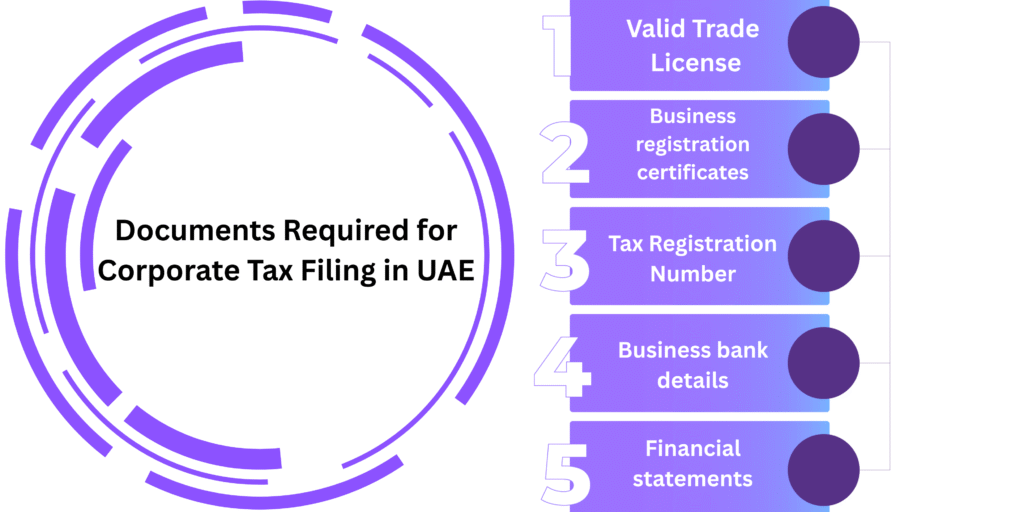
Documents Required for Corporate Tax Filing in UAE
To complete your corporate tax filing in UAE, businesses must prepare and maintain the following documents:
-
Valid Trade License
-
Business registration certificates
-
Financial statements (audited, if applicable)
-
Emirates ID and passport copies of owners/shareholders
-
Tax Registration Number (TRN)
-
Details of related party transactions
-
Income and expense statements
-
Bank account information
Corporate Tax Filing Process in UAE
Filing corporate tax in the UAE involves several key steps. Businesses should carefully follow each to ensure full compliance with FTA requirements.
Step 1: Register for Corporate Tax
Companies must register with the Federal Tax Authority (FTA) through the online EmaraTax portal to obtain a Corporate Tax Registration Number (TRN).
Step 2: Maintain Accurate Financial Records
Businesses are required to maintain detailed accounting records for at least seven years.
Step 3: Calculate Taxable Income
Taxable income is determined based on the net profit as per financial statements, adjusted according to the Corporate Tax Law.
Step 4: File Corporate Tax Return
A corporate tax return must be submitted within nine months after the end of the financial year.
For example, if your financial year ends on 31 December 2024, your return is due by 30 September 2025.
Step 5: Pay Corporate Tax
After submission, pay the applicable tax amount to the FTA through approved channels.
Corporate Tax Filing for Free Zone Companies
Free zone companies may enjoy 0% tax on qualifying income if they meet specific conditions, such as:
-
Maintaining adequate substance in the UAE.
-
Earning only qualifying income.
-
Complying with transfer pricing regulations.
However, if a free zone company conducts business with the mainland, part of its income may be subject to 9% corporate tax.
Penalties for Non-Compliance
Failure to comply with corporate tax filing in UAE can result in severe penalties:
-
AED 10,000 for failure to register.
-
AED 500 per month (up to AED 5,000) for late filing.
-
Additional fines for incorrect or incomplete submissions.
Hence, timely and accurate filing is essential to avoid unnecessary fines.
Benefits of Corporate Tax Filing in UAE
Filing corporate tax on time provides multiple benefits for businesses:
-
Legal Compliance: Ensures adherence to UAE tax laws and FTA regulations.
-
Improved Transparency: Builds investor trust through clear financial reporting.
-
Avoids Penalties: Prevents fines due to late or incorrect filing.
-
Business Credibility: Strengthens reputation in local and international markets.
-
Financial Discipline: Encourages better accounting and recordkeeping practices.
How Global Strategic Can Help
At Global Strategic, we simplify the entire process of corporate tax filing in UAE. Our experienced tax consultants provide:
-
Assistance with corporate tax registration.
-
Financial record management and audit support.
-
Accurate tax calculation and filing through FTA.
-
Ongoing compliance and advisory services.
We ensure your business stays compliant with UAE tax laws while optimizing your tax obligations.
FAQs About Corporate Tax Filing in UAE
1. What is the corporate tax rate in UAE?
The corporate tax rate is 9% on taxable income above AED 375,000.
2. Who must file corporate tax in UAE?
All UAE-registered businesses, including free zone entities (depending on qualifying income).
3. What is the deadline for filing corporate tax?
Corporate tax must be filed within 9 months after the end of the financial year.
4. Is corporate tax applicable to small businesses?
No, income below AED 375,000 is exempt from corporate tax.
5. Are free zone companies exempt from tax?
Yes, qualifying free zone entities enjoy 0% corporate tax on eligible income.
6. How to register for corporate tax in UAE?
Through the FTA’s EmaraTax portal using your business credentials.
7. What are the penalties for late filing?
AED 500 per month, increasing over time, along with other administrative fines.
8. Can foreign companies be taxed in UAE?
Yes, if they have a permanent establishment within the UAE.
9. Is corporate tax applicable on dividends?
No, dividends and capital gains are generally exempt if received from UAE companies.
10. What documents are needed for corporate tax filing?
Audited financial statements, TRN, bank records, and income details.
11. Can I amend my corporate tax return?
Yes, corrections can be made through the FTA portal with proper justification.
12. Is e-filing available for corporate tax?
Yes, all filings are done electronically via the EmaraTax system.
13. How long must records be kept?
Businesses must maintain tax and accounting records for seven years.
14. Are there any exemptions?
Yes, for government entities, public benefit organizations, and natural resource businesses.
15. Who can help with corporate tax filing in UAE?
Global Strategic offers full-service corporate tax registration, filing, and compliance solutions.
Conclusion
The introduction of corporate tax filing in UAE represents a major step toward building a transparent, sustainable, and globally aligned economy. While the UAE continues to maintain its reputation as a tax-friendly business destination, corporate taxation encourages businesses to adopt better financial discipline, accountability, and transparency.
Filing corporate tax is not just a legal requirement — it’s a strategic move that enhances the long-term stability and credibility of your business. Companies that comply with Federal Tax Authority (FTA) regulations are better positioned to attract international investors, secure funding, and expand their operations confidently.
By maintaining accurate accounting records, understanding tax laws, and filing returns within the stipulated deadlines, businesses can avoid penalties and maintain full compliance. Moreover, corporate tax filing in UAE gives companies an opportunity to review their financial health, identify profit areas, and make data-driven decisions for future growth.
For many companies, navigating the complex tax landscape can be challenging. That’s where professional support becomes essential. At Global Strategic, our experienced tax consultants provide end-to-end solutions — from corporate tax filing in UAE and financial documentation to accurate return filing and FTA compliance. We ensure that your organization remains fully compliant while optimizing your tax obligations in line with UAE law.
Whether you are a mainland company, a free zone entity, or an international business with operations in the UAE, proper corporate tax filing helps you operate smoothly and sustainably in today’s competitive market. Partnering with experts like Global Strategic guarantees precision, reliability, and peace of mind — allowing you to focus on what truly matters: growing your business.